Wearable sculpture
In wearable work, paper is compressed, folded and displaced into sculptural forms that can be visually substantial while remaining remarkably light.

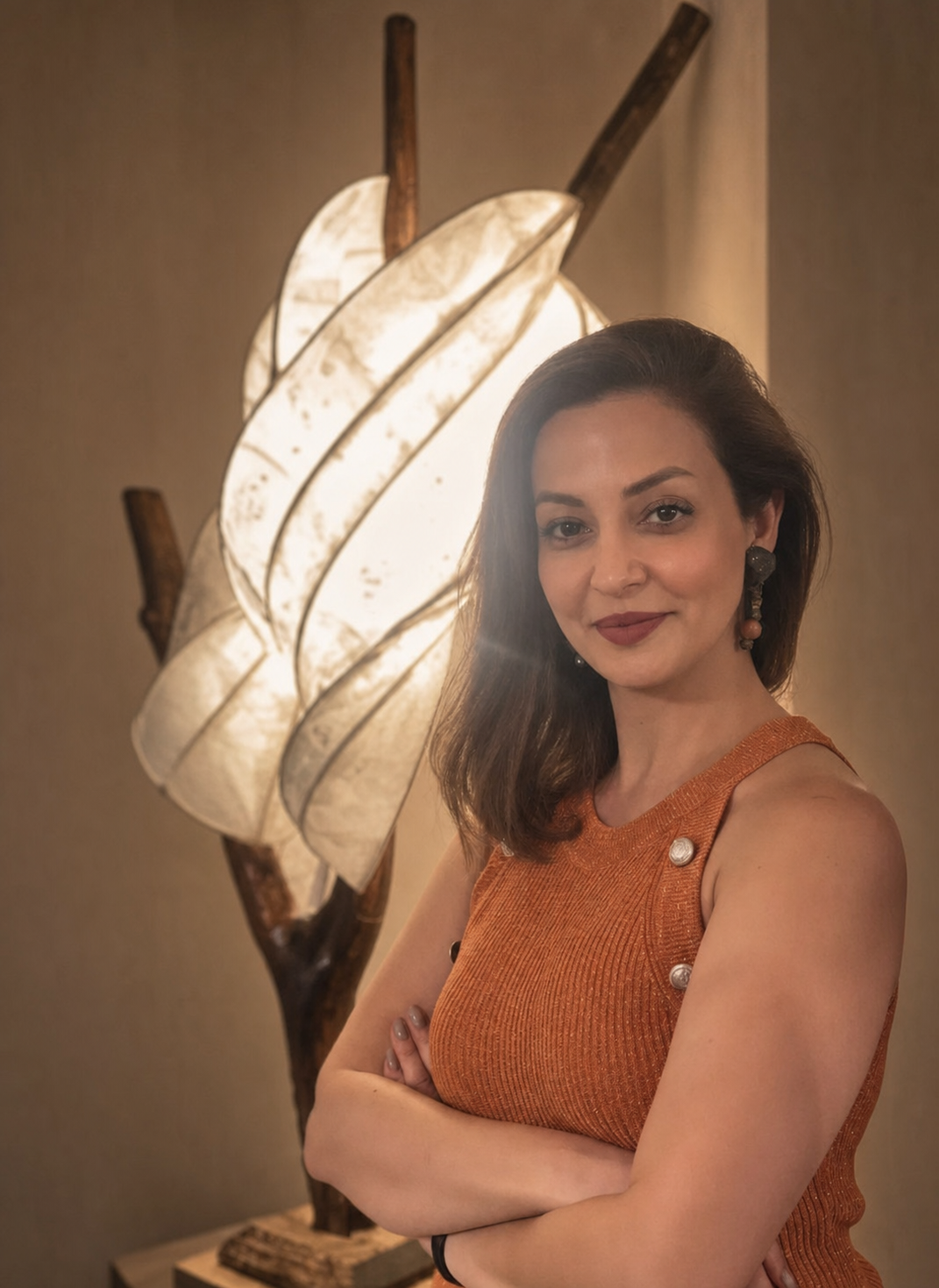
ARTIST & FOUNDER
I’m Sara Niknejad, the artist behind Niksa Design. I make wearable sculpture and sculptural light in Canada.
I explore how a form changes under pressure while carrying traces of what came before.
Explore wearable art · Explore sculptural light
Niksa Design began with a quiet observation in the Canadian landscape. I kept noticing fallen pieces of wood — cracked, twisted, weathered, sometimes already beginning to decay. They were slowly disappearing back into the landscape, yet I found them extraordinarily beautiful.
What stayed with me was that the forces acting on them had changed their form without completely erasing their identity. The cracks, bends and irregularities were not separate from what they had become; they were part of it.
That observation became the beginning of my practice.
A WAY OF SEEING
My background in architecture later gave me a language for understanding what I was already seeing in these forms — structure, weight, tension and balance.
It taught me to look at how a form stands, where it carries force, where it gives way, and how stability can exist without symmetry. Those ideas continue to shape the way I work with material today.
ONE PRACTICE · TWO SCALES
The practice now moves between two scales: objects carried by the body and objects held in space.
In wearable work, paper is compressed, folded and displaced into sculptural forms that can be visually substantial while remaining remarkably light.
In sculptural light, weathered wood becomes the starting condition. Structure, paper and light respond to what the wood already carries — its bends, fractures, weight and history.
The materials are different. The underlying question is the same.
THE WORK
I am interested in what happens when a material is allowed to move forward without being returned to an ideal state.
A crack can remain a crack. A fold can remain visible. A form can change its centre of balance. What matters is not the recovery of what existed before, but the possibility of another state — one that carries its history forward rather than concealing it.
The trace remains. The form continues.